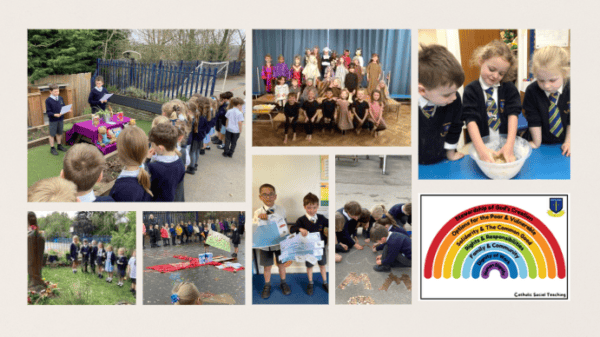
At St Mary’s, Catholic Social Teaching is at the heart of our mission and helps us to live out the Gospel in our everyday lives. Rooted in the teachings of Jesus, Catholic Social Teaching encourages us to recognise the dignity of every person, care for God’s creation and work together for the common good.
Through our Catholic Social Teaching themes, pupils learn that they are called to make a positive difference in the world around them. They develop an understanding of their responsibilities towards others, particularly those who are most vulnerable, and learn how their actions can contribute to building a more just and compassionate society.
These seven principles of Catholic Social Teaching underpin many aspects of school life:
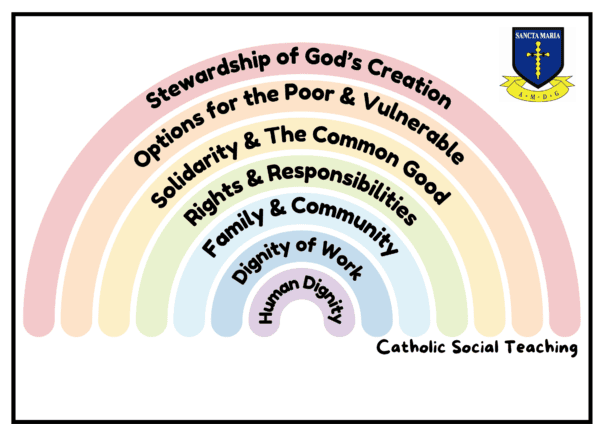
These principles are explored through prayer, worship, charity work, fundraising, pupil leadership opportunities and our wider Catholic Life.
Catholic Social Teaching Across the Curriculum
Catholic Social Teaching is not only taught within Religious Education. We make meaningful links across the curriculum so that pupils can recognise how their learning helps them understand their role in God’s world.
For example:
• In Geography, pupils explore global communities, inequality, Fairtrade and environmental issues, helping them understand solidarity, human dignity and stewardship.
• In History, pupils learn about significant individuals and events that have shaped society, exploring themes such as justice, equality, democracy, human dignity and the dignity of work.
• In Science, pupils develop awe and wonder in God’s creation through the study of animals, habitats, plants, space and the human body, whilst learning about responsibility for health and the environment.
• In Art, Design Technology and Music, pupils explore creativity as a gift from God, learn about the contributions of artists, designers, inventors and musicians, and develop respect for different cultures and communities around the world.
The documents below show how Catholic Social Teaching is woven through each curriculum subject and provide examples of where pupils encounter these principles throughout their learning journey from KS1 to KS2.