Our school vision – ‘We live and learn by journeying with Jesus for the greater glory of God’.
Religious Education is a core subject, therefore finding itself at the centre of our academies. All students receive Religious Education from the moment they start, to the moment they leave school. As an academic subject it is rigorously planned and delivered with the same expertise as all other core subjects. However, Religious Education is more than just an academic subject. It informs our faith, nurtures our personal quest for God and inspires us to continue on our quest for a greater understanding of God and God’s creation. Visit our Religious Education page to find out more.
At St Mary’s; we believe that our faith is at the centre of all we do and as such the catholic life and our daily worship is an integral and special part of our daily life. Our Religious Education (RE) curriculum works alongside the catholic life and collective worship elements in order to develop the children’s’ love and understanding of the catholic faith. We believe that our Religious Education lessons enable children to grow a deeper understanding of our faith and beliefs and enable them to build a better relationship with God and others because by learning and journeying with Jesus we can come to see how we can follow in his footsteps.
Aims and Objectives
Our school vision:
‘We live and learn by journeying with Jesus for the greater glory of God’.
Religious Education is a core subject, therefore finding itself at the centre of school life. All students receive Religious Education from the moment they begin their journey at St Mary’s, to the moment they leave. As an academic subject, it is rigorously planned and delivered with the same expertise as all other core subjects. However, Religious Education is more than just an academic subject. It informs our faith, nurtures our personal quest for God and inspires us to continue our quest for a greater understanding of God and God’s creation.
At St. Mary’s we believe that our faith is at the centre of all we do and, as such, the Catholic life and daily worship is an integral and special part of our daily life. Our Religious Education (R.E) curriculum works alongside the Catholic life and prayer and worship elements to develop the children’s’ love and understanding of the Catholic faith. We believe that our Religious Education lessons enable children to grow a deeper understanding of our faith and beliefs and enable them to build a better relationship with God and others because by learning and journeying with Jesus we can come to see how we can follow in his footsteps.
‘I will instruct you and teach you in the way you should go; I will counsel you with my loving eye on you.’
Psalm 32:8
The aims/objectives of teaching Religious Education at St Mary’s Catholic Voluntary academy are: –
- that our children come to know God through prayer, community and learning.
- to reveal the love of God to each child.
- to gain an understanding of the liturgical year through learning about the churches’ main feasts and festivals, especially those linked to Mary, our patron saint and role-model.
- to be able to retell, talk about, describe and understand Bible scripture.
- to learn how to grow in the Gospel values of love, compassion, forgiveness, hope, humility, justice and integrity and learn how we can apply these can be applied to everyday situations.
- to study scripture and learn about different ways to pray and enjoy discovering how singing hymns, liturgical dance and times of silence can all be a form of praise and worship and allow us space and time to develop our relationship with God.
- to provide children with opportunities to reflect and renew.
- to help children develop a sense of self and to aspire to be the best person they can be and to celebrate their God given talents and uniqueness.
- to grow in knowledge and understanding of the Sacraments.
- to understand and be respectful of their own and others beliefs and values and to develop positive attitudes to all.
- to learn about other faiths such as Judaism, Hinduism, Sikhism and Islam.
- to learn about other faiths such as Judaism, Hinduism, Sikhism and Islam.
At school, we follow the Diocese of Nottingham curriculum scheme of work, ‘Meet in my name’. From Key Stage One, 10% of curriculum time is devoted to Religious Education, excluding assembly and celebrations of the Word, as advised by the Bishops of England and Wales. This distinguishes RE from other subjects and so reminds us that RE is unique and special within our curriculum. In EYFS Religious Education can be taught in discrete lessons and accessed during continuous provision.
This ‘Meet in my name’ scheme is rich with scripture and prayer, exploring the lives of saints and other religious people. A series of ‘Big Questions’ drive each topic. These questions provide the children with opportunities to explore and develop their thinking, challenge themselves and then return to the question at the end of the topic for reflection. The RED uses the knowledge lenses Hear, Believe, Celebrate and Live to help pupils understand Scripture, Catholic beliefs, worship, and how faith is lived out in daily life. It also uses Dialogue and Encounter to develop understanding and respect for people of other faiths and worldviews.
The Religious Education Directory consists of six branches, across each year group to allow children to discover, develop and deepen their understanding as they move through the school. The programme of study identifies precise knowledge which is built up over time. They follow a sequential narrative and are revisited with deepening theological complexity as students progress through each year group. The Knowledge Lenses dictate what students should look at and know by the end of each age phase. They ensure that every branch includes a mix of Scripture, Church doctrine, prayer, and lifestyle as children explore the religious understanding through the Hear, Believe, Celebrate and Live lenses. The “ways of knowing” act as the underlying skill framework, guiding how students process the theological information they learn as they Understand, Discern and Respond.
EYFS
In Nursery and Reception, Religious Education is delivered through taught sessions, adult led activities and continuous provision, both inside the classroom and in the outdoor environment. Children are given the opportunity to explore aspects of faith through prayer times, circle time discussions and hands on explorative play opportunities such as re-enacting a Baptism or visiting the local church.
The children follow the Early Years Foundation Stage Framework, in which aspects such as PSED (Personal, Social, Emotional Development) and UTW (Understanding of the World) provide opportunities for teachers to embed aspects of the ‘Meet in my name’ themes into classroom activities in an age-appropriate way.
KS1 and KS2
In KS1 and KS2 children learn about the churches’ feasts, festivals and Sacraments as well as having plenty of opportunities to study scripture. In KS1 children recognise religious scripture, describe and retell stories and events and reflect upon what they have learnt. In KS2 children comparing or by making links between scripture, explain signs and symbols, prayer, hymns. The programme of study identifies precise knowledge which is built up over time. Throughout KS1 and KS2 children discuss how they can apply and live out this learning in their everyday lives through our thoughts, words and actions. Throughout the curriculum, children encounter and explore faith through the lenses of Hear, Believe, Celebrate and Live, supporting them in developing religious knowledge, spiritual understanding, and a lived response to the Gospel.
Religious Education is taught through a variety of approaches that enable children with different learning needs and strengths to access and participate fully in the curriculum.
Opportunities are given for:
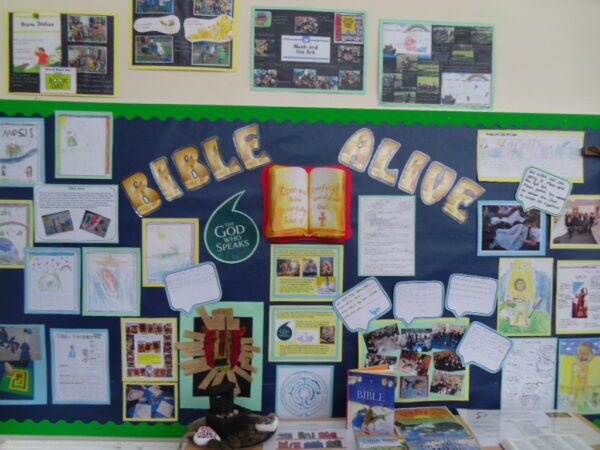
- developing a religious literacy and understanding of their faith by reading, discussing, retelling and describing a range of Scripture.
- painting, making and crafting responses to Religious themes and bible stories
- extended opportunities for creative writing, such as composing your own psalm or a letter in style of St. Paul
- creating or performing liturgical dance
- using drama skills such as conscience alley, freeze frame, re-enacting and hot seating to gain a greater understanding of bible stories or religious events such as the Eucharist or Baptism.
- discussion and group tasks to challenge thinking and allow for exploration and opportunity to share their own thoughts, feelings and responses.
- to create prayers that express their own thoughts, feelings and faith.
- to reflect upon and celebrate what they have learnt through activities such as class liturgies linked to the end of each topic.
- to make links between hymns, prayers, scripture and how other people such as saints have been able to follow the gospel values
- To investigate how charities support vulnerable people and communities, developing an understanding of Catholic Social Teaching principles such as human dignity, the common good and care for creation.
The Religious Education curriculum is further enriched through our own extra-curricular activities such as Mission Days. These provide a special opportunity for children to take a day to fully engross themselves in a particular religious theme, which they can then make celebrate their learning with the whole school through worship and prayer.
Feedback is an integral part of all lessons; it is an essential tool to enable pupil’s progress. A range of feedback used during RE lessons:
Peer Feedback – Within all lessons, pupils are given an opportunity to feedback to each other, whether it is during group work or through the opportunity to discuss their learning and understanding with each other during Learning Partner times.
Teacher Feedback – Verbal feedback is given throughout all lessons. Teachers give feedback as they continually assess pupils’ learning. This is evident through 1:1, small group and whole class feedback. Teachers mark books in line with the school marking policy, encouraging children to respond to comments to enable pupils to take their learning forward.
Self-Assessment Feedback – Pupils are encouraged in every lesson to self-assess in the form of retrieval activities and reflection, as well editing and responding to marking. At the end of each topic pupils are given a chance to reflect upon and celebrate their learning during a planned whole school ‘respond’ session. In class groups, there is also an opportunity for each child to look over the key objectives of that topic and make an individual response to demonstrate their progress, retrieval and recall.
Each topic, teachers will review an individual’s learning of the key objectives from the branch and use this to inform planning and guide pupils to the next steps. Religious Education results and data are presented to parents as part of our end of year reports. There is also an opportunity to discuss the children’s learning and any targets at our parents’ evenings in the Advent and Lent terms.
Resources
Each class has access to bibles and prayer books as well as an area for prayer and reflection. There are other faith resources, which are stored centrally for the shared use of classes across the school. We have specially dedicated areas of school where children can go to spend time in quiet contemplation or to share with their peers their faith, including the Mary Garden.
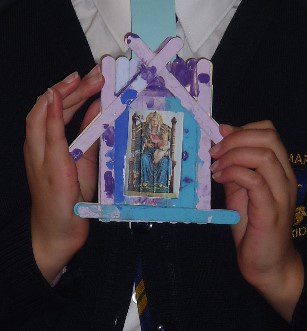
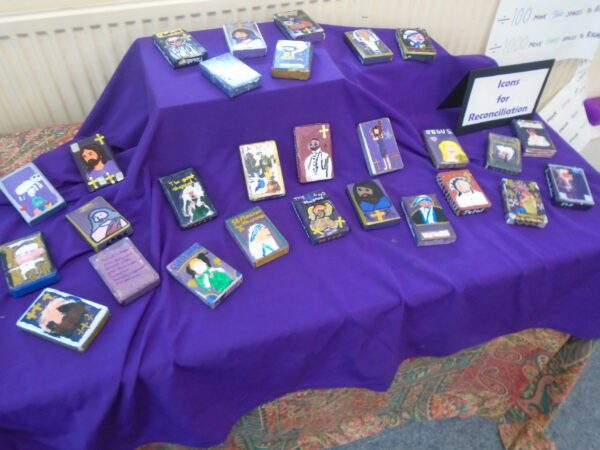
Each class has access to bibles and prayer books as well as an area for prayer and reflection. KS2 classes have further resources linked to helping children build links and connections and these are created by the specific year groups. There are some other faith resources, which are stored centrally for the shared use of classes across the school.
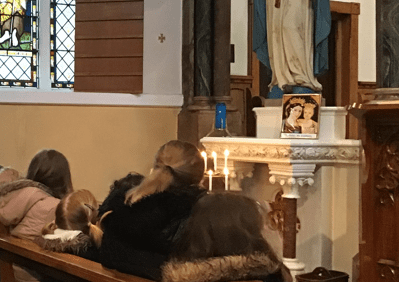
We have specially dedicated areas of school where children can go to spend time in quiet contemplation or to share with their peers their faith. One of these spaces is situated outside: our Mary Garden and the other is indoors, our Holy Hub. The Holy Hub is set up with religious books and artefacts and a range of seating and is also used by groups or classes as part of their learning or when specific groups such as Y6 guiding lights or the school Faith Friends need to meet or where children can go to plan school liturgies or have moments of peace.
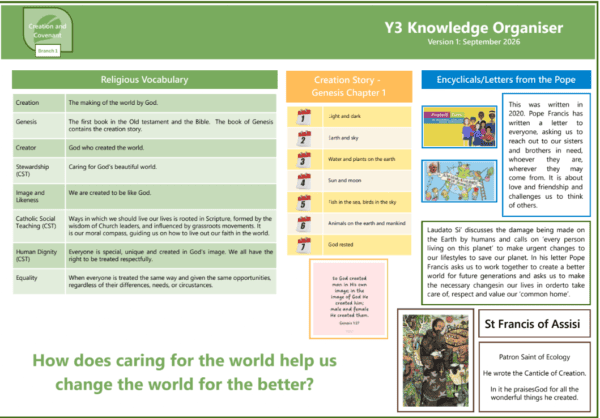
Knowledge Organisers for each topic can be found on the class Teams page.
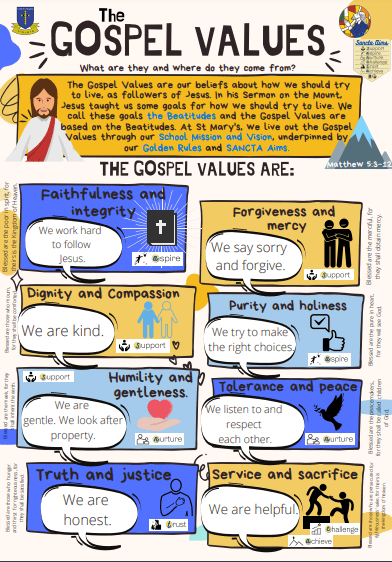
As a catholic school we put our faith at the centre of all we do and learn. Religious Education and Collective Worship form an integral part of the overall Catholic Life of the school and we strive to embed the values we learn in our Religious Education lessons into all other subjects. The values we learn through our RE lessons also support our whole school behavioural plan as our rules are based around the Gospel values, and in particular the message:
“Love one another as I have loved you.” John 13:34
Catholic Social Teaching is woven throughout the RED by helping pupils understand how faith influences the way we live and treat others. The CST themes are explored through Scripture, Catholic beliefs, prayer, and action. Opportunities are identified across the wider curriculum to reinforce these themes, helping pupils understand how faith can be lived out in everyday life and in response to local and global issues.
- Multi-cultural Statement
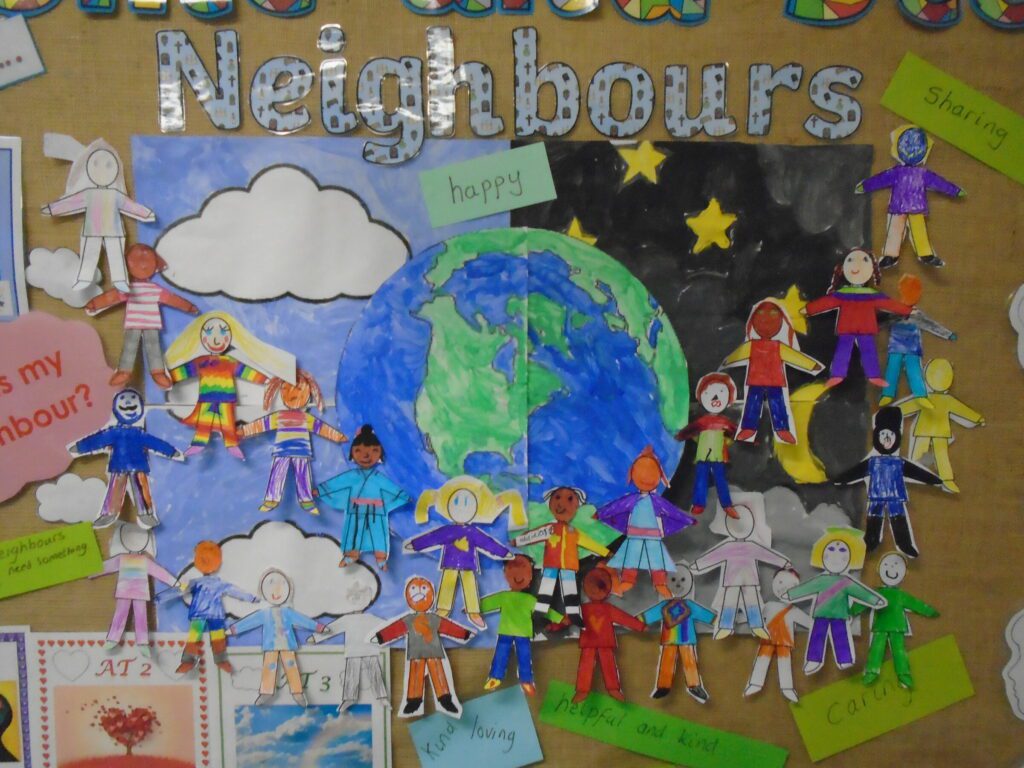
We regard it as essential that our children develop an understanding and respect of other faiths. All children, whatever their faith, attend and participate in Celebrations of the Word and Masses.
Through the Dialogue and Encounter branch, children learn about other world faiths and worldviews by exploring the beliefs, traditions and practices of different communities. They are encouraged to engage respectfully with similarities and differences, helping them develop understanding, appreciation and a commitment to working together for the common good. Throughout the academic year, we provide opportunity to study Judaism, Islam, Hinduism Sikhism and other Dharmic religions faiths.
Links to Community, Locality and Trips
- We have strong links to the local parishes of Marple Bridge and Marple. Children regularly attend mass at our local Parish church and make visits there to enhance their studies.
- At significant liturgical times of the year, we share mass with local parishioners who are invited into school; sing carols and share the Christmas and Easter stories with parents through school performances.
- We have visits from both parish priests as part of our celebration of mass but also to visit classes and talk with the children.
- During our other faith weeks from time to time we invite speakers from other faiths to make visits. We welcome visitors, parents and grandparents into school to share their faith experiences.
The Subject leader has a variety of roles. These include:
- Taking the lead in policy development and quality assuring the planning, delivery and assessment of Religious Education.
- Supporting colleagues in their development and implementation of the teaching of Religious Education.
- Monitoring progress in Religious Education and advising the Senior Leadership Team and Governors on action needed.
- Using release time to support colleagues and disseminate information.
- Auditing resources, monitoring and directing the spending in relation to the subject
- Keeping up-to-date through research and continuing professional development and attendance at Religious Education co-ordinators meetings.
- Encouraging staff to attend relevant training and planning meetings to support them in the delivery of the subject.
- To work alongside the Senior Leadership team to produce the annual data for the diocese.